
How Consumer Values, Inflation and ‘MAHA’ Are Reshaping the Natural & Organic Landscape
This article first appeared in the May 2026 issue of Presence Marketing’s newsletter.
By Steven Hoffman
In our recent analysis, Organic Outpaces the Market: Global Sales Hit Record Highs as U.S. Crosses $76B, we highlighted a defining economic reality of the 2025-2026 marketplace: Organic food is no longer a niche preference, but a primary economic driver. But the raw sales data tells only half the story. As a “bookend” to that financial milestone, we must dive deeper into the complex, often contradictory psychology of today’s natural and organic consumer.
Food industry thought leader Robyn O’Brien, author of The Unhealthy Truth, once famously noted,”We are not allergic to food. We are allergic to what has been done to it.” That sentiment has never been more relevant than it is today. Consumers are deeply engaged with how their food is grown, processed, and regulated. Yet, they are also navigating an unprecedented maze of economic pressures, political crossfires, confusing sustainability claims, and loud social media detractors.
To chart a successful path forward, natural products brands, retailers, and investors must intimately understand the shifting demographic attitudes toward organic food, regenerative agriculture, pricing, and the policies governing our plates.
The K-Shaped Economy: Valuing the Price of Organic Amidst Inflation
Food inflation and the resulting price elasticity of consumer goods have been the central plotlines of the grocery sector over the last few years. How are food prices affecting the natural and organic products consumer? The reality is nuanced.
According to recent analysis by CoBank, consumers are exploring a range of approaches to handle double-digit cost increases. Looking at the specialty coffee and beverage sector as a bellwether, consumer price index (CPI) data showed coffee prices jumping 18.3% year-over-year in early 2026, leading to a noticeable shift in consumer behaviors, including a retreat to do-it-yourself, at-home preparation.
When it comes to organic goods, consumers are highly sensitive to the premium, yet they continue to buy. CoBank points out that in our increasingly “K-shaped economy”—where the top 10% of wealthy Americans account for roughly half of all consumer spending—the high base price of organic products risks limiting its ultimate audience to higher-income brackets. Recent LendingTree research cited by CoBank notes that organic produce commands a 52.6% price premium over conventional counterparts.
However, despite this premium, organic sales are not stalling; they are growing at 6.8%, double the 3.4% rate of the broader marketplace. Produce remains the undisputed gateway, accounting for 30% of the nation's total organic sales ($22.7 billion).
Consumers view organic produce as an affordable, high-return entry point into health and wellness. They may balk at a $9 organic specialty beverage, but they will readily pay an extra dollar for organic berries or bananas to avoid synthetic pesticides. For the industry to maintain its momentum and avoid being boxed into an elite, high-income corner, the expansion of competitively priced organic private labels, focusing on supply chain efficiencies and economies of scale, and adopting more collaborative partnerships with co-packers and others to cut production costs will be critical.
Deciphering Purchasing Decisions: Safety, Price, and Demographic Heterogeneity
So, just how important is the organic label when a consumer is standing in the grocery aisle making a split-second purchasing decision?
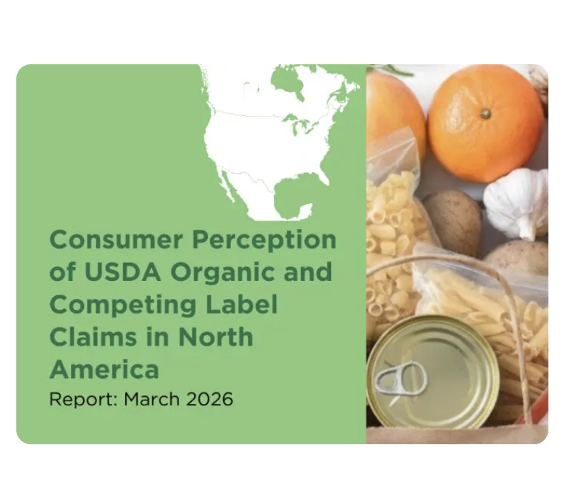
According to the brand-new Consumer Perception of USDA Organic Report released in March 2026 by the Organic Trade Association (OTA) and Euromonitor, organic continues to hold a distinct edge over competing label claims like “natural,” “non-GMO,” and “raised without antibiotics.” As the OTA’s newly launched April 2026 Organic Starts with You campaign underscores, the USDA Organic seal remains the clearest, most credible signal for consumers seeking trust in a crowded marketplace.
Also, a 2026 Best-Worst Scaling study published in Q Open examining U.S. rice consumers provides critical insights into the modern shopper's mindset. The study reveals that across the board, food safety and price remain the most influential factors in purchasing decisions. But beneath those universal priorities lies profound demographic heterogeneity, which researchers divided into four distinct consumer segments: conventional, pragmatic, sustainability-conscious, and low-engagement.
Conventional: Older demographics tend to focus predominantly on price and domestic origin, showing less willingness to pay a premium for ecological farming methods.
Pragmatic: This is arguably the most vital group for marketers to understand. Comprising younger and educated consumers, the “pragmatic” shopper is highly interested in sustainability and regenerative agriculture—but they exhibit deep skepticism toward traditional “organic” marketing claims.
Sustainability-Conscious: This segment, heavily skewing toward younger, highly educated, and higher-income consumers, strongly prefers organic and regenerative attributes. For them, the organic seal is a non-negotiable baseline for environmental stewardship and personal health.
Low Engagement: This consumer shows little to no interest in organic attributes.
The pragmatic segment highlights a growing challenge: The younger cohort is deeply invested in the idea of sustainable food, but they are scrutinizing the validity of certifications. They want the benefits of organic—clean soil, no pesticides, biodiversity—but they are increasingly vulnerable to alternative claims like "regenerative," even when those alternative labels lack strict regulatory definitions.
At the same time, conventional and low-engagement consumers may require accessible education to build awareness and trust in non-conventional farming practices. Additionally, the overlap between regenerative and organic preferences underscores the need for standardized labeling and consistent communication to help consumers meaningfully differentiate between these production systems.
Meeting Increased Demand for “Clean Label” Products
Despite the skepticism of some pragmatic shoppers, the broader consumer base intrinsically links the organic seal to the “clean label” movement. According to breaking data from SPINS’ 2026 Trend Predictions, the clean-label and Non-UPF (non-ultra-processed food) movements also are gaining massive momentum, driven by consumer skepticism, proactive brand reformulation, and younger generations rejecting rigid diets in favor of personalized, clean-ingredient nutrition.
Echoing this shift, recent coverage by SupplySide Food & Beverage Journal notes that the clean-label movement has transitioned from a niche premium differentiator into a baseline consumer expectation. Today’s consumers define natural and organic through a lens of total transparency and purity. In fact, NIQ’s (NielsenIQ) latest 2026 Consumer Outlook reveals that brand trust has become the ultimate currency, with an overwhelming 95% of consumers stating that trust is critical when choosing a brand.
Consumers are backing up this sentiment with their wallets. According to NIQ, clean label products in the U.S. are currently growing at a rate of 7.5% this year, significantly outpacing the 5.9% overall average for U.S. fast-moving consumer goods (FMCG).
Recent research by Innova Market Insights shows that globally, 58% of consumers prioritize honesty and transparency in products, with the top influential purchasing claims being “natural,” “locally sourced,” and “organic.” Furthermore, a 2025 global consumer trends survey from Market Research Future underscores that this shift is heavily driven by younger demographics. The study found that 64% of Gen Z consumers actively seek out clean-label claims such as “organic,” “no artificial ingredients,” and “minimally processed.” SupplySide notes that consumers are reading labels more closely than ever, demanding that brands invest in sustainable sourcing and formulation technologies that preserve shelf life and sensory appeal without compromising the “clean” promise.
To meet this increased demand, the natural and organic industry has expanded its footprint across standard supermarkets, convenience channels, and e-commerce platforms. But meeting mainstream demand brings significant operational hurdles. The industry continues to grapple with supply chain bottlenecks, real-time raw material shortages, and the ongoing challenge of maintaining consistent global sourcing standards. As brands scale, maintaining the transparency that consumers demand—proving that the product is as “clean” as the label implies—is becoming a defining operational challenge … and an opportunity.
Pesticides and the MAHA Influence: For Better and For Worse
The consumer desire for “less/no pesticides/chemicals” is currently colliding with an increasingly politicized food system, most notably the profound influence of the “Make America Healthy Again” (MAHA) movement. Led by political figures and advocates pushing to upend the FDA and USDA, MAHA has dramatically shifted the national conversation around food and agriculture—yielding intensely mixed results for the natural and organic industry.
The Better
The MAHA movement has successfully thrust the concept of “food as medicine” into the mainstream political arena, validating concerns that natural and organic industry advocates have championed for decades, as reported by SupplySide Food & Beverage Journal and many others. By aggressively targeting petroleum-based artificial food dyes, seed oils, and ultra-processed foods (UPFs), MAHA has elevated everyday consumer awareness about clean ingredients to unprecedented heights. This populist uproar against the conventional, highly processed food system inherently drives traffic toward the natural and organic aisles, where consumers know they can find refuge from artificial ingredients.
The Worse
However, when it comes to the bedrock of organic farming—the prohibition of synthetic toxic pesticides—the MAHA influence has been far more complicated. Environmental watchdog groups note that despite the populist rhetoric regarding health, the current political administration’s actual policy execution has heavily favored chemical agribusiness, much to the chagrin of many MAHA proponents, according to a recent report from Politico.
Rather than restricting toxic agricultural inputs, there has been a trend of pesticide protectionism that is further frustrating health proponents, NPR reported in April 2026. We are witnessing regulatory rollbacks regarding risk evaluations for hormone-disrupting chemicals and a startling lack of new federal pesticide restrictions. Furthermore, 2025 and 2026 saw federal funding freezes and delays for critical programs meant to assist farmers transitioning to organic systems. This creates a paradox: Consumers are being told by political influencers to eat cleaner, healthier food, while the very mechanisms needed to scale organic farming and protect rural communities from toxic chemicals are being undermined at the federal level.
Defending the Shield: Countering the Social Media “Gaslight” Narrative
This political turbulence is mirrored by a growing, concerning cultural backlash against organic food on social media. If the organic industry wants to protect its $76 billion market share, it must learn how to aggressively and effectively counter negative PR.
As highlighted in a poignant April 2026 newsletter by Organic Insider, a rising tide of large content creators, fitness influencers, and self-appointed “truth-tellers” on Instagram and TikTok have been relentlessly attacking the organic industry. They are going viral by calling organic food “the greatest gaslight of all time,” “worthless,” and “a scam.”
Max Goldberg of Organic Insider, correctly identifies this trend not as a good-faith critique of a flawed agricultural system, but as the “monetization of destruction.” These influencers are farming clicks and outrage by tearing down the organic seal, yet they offer no constructive alternative framework, Goldberg says.
If the organic system were to be dismantled by this wave of social media cynicism, what would we be left with? We would be left entirely with the conventional food system—a system optimized for cheap, extractive production where crops are routinely desiccated with glyphosate, a known carcinogen, and sprayed with dicamba, a highly toxic pesticide. We would be left with a system reliant on genetically engineered crops, synthetic biology, and the total externalization of environmental costs onto rural farming communities.
To counter this negative PR, organic brands and marketers must stop playing defense and start playing offense. For example:
Elevate the Farmer: The influencers calling organic a scam will never look a fourth-generation farmer in the eye—someone who has spent years earning certification, paid thousands in annual fees, and worked without synthetic shortcuts—and tell them their life’s work is a gaslight. Brands must put these farmers front and center in their marketing campaigns. Show the soil. Show the labor. Show the humanity behind the seal.
Educate on the Alternative: Brands must clearly articulate what the absence of organic means. Remind consumers that organic federal certification mandates soil health standards, annual certifier inspections, chain-of-custody requirements, and a strict prohibition on synthetic pesticides and GMOs.
Acknowledge and Improve: As Organic Insider notes, the organic system is not perfect. The industry must publicly champion stronger enforcement and the elimination of fraud. Transparency builds trust; defensiveness destroys it. By acknowledging flaws while fiercely defending the system’s foundational principles, the industry can win back the “pragmatic” consumers who are currently paralyzed by social media skepticism.
The Path Forward
The market research of 2026 paints a complex, highly dynamic picture for the natural and organic industry. Consumers are highly motivated and willing to pay a justified premium for clean, safe food, even amidst tightening economic belts. They are increasingly savvy about the links between agricultural practices, environmental resilience, and their own health.
However, the industry is no longer operating in an echo chamber of early adopters. It is operating in a noisy, politically charged, and economically stressed mainstream marketplace. As terms like “regenerative” risk being co-opted by conventional agriculture to obscure ongoing pesticide use, and as social media algorithms reward outrage over nuance, the mandate for organic brands is crystal clear: uncompromising transparency and bold advocacy.
Relying on the rigorously audited USDA Organic seal and also newer, Regenerative Organic Certified (ROC) standards—while relentlessly educating consumers on why organic remains the gold standard for pesticide-free, non-GMO food—will be the most vital strategy for retaining consumer trust, justifying the price premium, and securing the next generation of growth for the natural and organic products sector.
Steven Hoffman is Managing Director of Compass Natural Marketing, a strategic communications and brand development agency serving the natural and organic products industry. Learn more at www.compassnatural.com.