
Can Trump’s Support Move the Needle on CBD?
Could President Donald Trump's recent endorsement of hemp-derived CBD products provide new momentum for an industry that has struggled in recent years under a patchwork of inconsistent state and federal regulations?
This article first appeared in the November 2025 issue of Presence Marketing’s newsletter.
By Steven Hoffman
In what industry observers have called a surprise move, on Sept. 28, President Donald Trump posted a video on his Truth Social platform promoting the health benefits of cannabinoids, suggesting that covering hemp-derived CBD under Medicare would be a “game changer” and “the most important senior health initiative of the century.” At a time when some members of Congress are pushing for policy changes that could upend the CBD market, Trump’s implied endorsement of CBD is remarkable.
Trump’s post supporting Medicare coverage for CBD products sparked a 36% rise in publicly traded cannabis stocks in the weeks that followed, Yahoo Finance reported. The post also raised hopes that the White House might take a more permissive approach to marijuana regulation following Trump’s statement in August that his administration was exploring a potential reclassification of marijuana — an effort originally proposed under the Biden administration. Removing cannabis from its Schedule I status would mean the federal government acknowledges the plant’s medicinal value.
“I’ve heard great things having to do with medical, and I’ve [heard] bad things having to do with just about everything else,” Trump said during an Aug. 11 White House press conference. “But medical and for pain and various things, I’ve heard some pretty good things.”
The video Trump shared was produced by The Commonwealth Project, an organization dedicated to improving health and longevity for older Americans. It was founded by Howard Kessler, a billionaire and philanthropist with ties to the CBD industry and a longtime friend of Trump’s. According to Independent Voter News, Kessler believes “that medical cannabis could be harnessed to not only provide older Americans with an alternative to traditional prescription painkillers but to reduce soaring health care costs saddling millions of seniors.”
In the video promoted on Truth Social, CBD was described as a way to "revolutionize senior healthcare" by helping reduce disease progression. The narration claimed CBD could help “restore” the body’s endocannabinoid system and ease pain, improve sleep and reduce stress in older adults. It also cited a Fox News segment referencing a Price Waterhouse Coopers report that estimated potential cost savings of “$64 billion a year if cannabis is fully integrated into the healthcare system.”
A Boston- and Palm Beach, Florida-based entrepreneur and philanthropist, Kessler founded Kessler Financial Services, which helped pioneer affinity credit cards. He later obtained one of Massachusetts’ first medical marijuana licenses in 2014, and became the state’s first recreational seller before his company was acquired by a Georgia cannabis firm in 2019. In June 2024, Kessler appeared on Fox News to discuss his efforts to integrate medical cannabis into traditional health care for seniors.
Regulatory Confusion Hinders CBD Market
Regulations around the commercial use of hemp and CBD were significantly eased across the U.S. when industrial hemp was legalized under the 2018 Farm Bill during Trump's first term. However, since its passage, a growing number of state-level battles and lawsuits have emerged regarding the definition of hemp, the “intoxicating hemp” loophole around hemp-derived Delta-8 THC, and the lack of consistent federal and state regulatory frameworks for the cultivation, manufacture, marketing and sale of hemp-derived cannabinoids such as CBD, according to national law firm Buchanan Ingersoll & Rooney.
Trump’s implied endorsement of CBD comes as a bipartisan group of lawmakers pushes back against attempts to ban hemp-derived THC products, arguing that such action would “deal a fatal blow” to the hemp industry and violate congressional rules. In a letter sent to House Speaker Mike Johnson (R-LA) on Sept. 26, House Oversight and Government Reform Committee Chairman James Comer (R-KY) and 26 other members warned that appropriations legislation containing hemp ban provisions would devastate the industry that emerged after hemp’s 2018 legalization.
A group of eight Democratic senators also sent a letter in September urging leadership to pursue regulation rather than prohibition, warning that banning products containing any amount of THC would trigger major upheaval in the hemp market. (Under the 2018 Farm Bill, hemp is legally defined as containing no more than 0.3% THC on a dry weight basis.) Meanwhile, dozens of hemp farmers from Kentucky have urged Senate Minority Leader Mitch McConnell (R-KY) to back away from efforts to re-criminalize certain hemp-derived products, Louisville Public Media reported.
Kentucky Sen. Rand Paul also warned that the cannabis policy movement has “swung hard on the prohibitionist side.” In June, he introduced the Hemp Economic Mobilization Plan (HEMP) Act to counter potential restrictions, proposing to triple the amount of THC allowed in hemp while addressing several other regulatory challenges facing the industry.
For its part, the U.S. Food and Drug Administration (FDA) reaffirmed in January 2020 that it is unlawful to introduce food containing added CBD into interstate commerce, or to market CBD as, or in, dietary supplements. Now, according to Marijuana Moment, while Trump was endorsing CBD on Truth Social, the FDA quietly updated its adverse drug event reporting forms to track incidents related to hemp-derived cannabinoids, including CBD — part of an effort to gather more data on potential health effects associated with such products.
Hemp Industry Responds to President’s Support
In an Oct. 7 letter to President Trump, Jonathan Miller, legal counsel for the U.S. Hemp Roundtable, praised the president’s acknowledgment of hemp’s potential and urged him to oppose the proposed hemp ban:
"The recent video you shared about the extraordinary value of hemp products was important, raising awareness on the positive impact our American-grown and manufactured products have. Here at the U.S. Hemp Roundtable, our members are focused on giving Americans choices in improving their overall health and wellness ... but now we need your help! Congress is close to passing a hemp ban, reversing the work you led in 2018 to make hemp blossom. A proposed definition change to hemp, being touted as protecting Americans, would wipe out 95% of this uniquely American industry that you are so proud of,” Miller stated.
He continued: “A more effective way to protect American consumers and jobs would be to support and demand robust hemp regulation — age restrictions along with uniform testing, labeling, and packaging requirements. Outright prohibition is not the answer, nor would it make anyone safer. Banning legal hemp products that are already regulated at the state level will not protect consumers; it would only shift hemp to the black market and destroy a rising American industry in the process. ... A ban would put American farmers, American businesses, American consumers, our veterans, seniors, and more than 328,000 American workers at risk."
Miller added that "American voters are on your side on this issue. In Texas, a state with a rapidly growing hemp market, 76% of your voters and 78% of seniors favor legal, regulated hemp sales. In fact, more than 62% of Texans say they are more likely to support candidates who back the regulated sale of hemp-derived products."
Bottom line: Trump’s apparent support for CBD could mark a turning point for a sector long constrained by legal uncertainty. Whether the endorsement leads to meaningful policy change remains to be seen — but it has already reignited momentum, investment, and public discourse around hemp-derived wellness products in America’s fast-evolving natural health market.
Steven Hoffman is Managing Director of Compass Natural Marketing, a strategic communications and brand development agency serving the natural and organic products industry. Learn more at www.compassnatural.com.
After Boom and Bust, Could Hemp Market Be Stabilizing?
This article first appeared in the May 2024 issue of Presence Marketing’s newsletter.
By Steven Hoffman
Could the hemp industry be on the cusp of a turnaround? After several years of volatility for U.S. hemp growers, prices and acreage in many states are beginning to stabilize or are rising modestly, according to the National Hemp Report, published by the U.S. Department of Agriculture (USDA) in April 2024.
According to the USDA, the value of U.S. hemp crop production in 2023 totaled $291 million, up 18% from 2022. Based on a survey sent out in January 2024 to producers across the country as part of USDA’s national agriculture census, the report shows signs of renewed market growth and improved on-farm efficiencies. “There was the big boom, then the big falloff, and this year everything is sort of leveling out,” Joshua Bates, a USDA statistician who wrote the landmark National Hemp Report, told MJBiz Daily.
“The hemp industry is stabilizing into its various categories including: 1) cannabinoids, nutraceuticals and flower; 2) food, feed and nutrition; and 3) fiber and industrial materials and applications. At this time, a much clearer picture is emerging as to where these categories can end up over the next three, five and ten years,” said Morris Beegle, publisher of Let’s Talk Hemp and producer of NoCo Hemp Expo, the leading trade show and conference for the hemp industry.
“The past several years posed significant challenges, starting with the pandemic’s onset and exacerbated by the federal government’s regulatory ambiguity regarding CBD and hemp-derived cannabinoids. Add to that burdensome regulations imposed on farmers endeavoring to cultivate hemp fiber and grain – crops that deserve equitable treatment akin to any other commodity. Such circumstances deter participation in this budding industry. What we truly require are coherent federal regulations applicable universally, instead of disjointed state-level initiatives that render the industry vulnerable and unsupported,” Beegle said.
Recovery on the Horizon
Production of industrial hemp for food, fiber and flower took off after it was legalized in the 2018 federal Farm Bill. In the years before the Covid pandemic, hemp acreage was on the rise, entrepreneurs and investors flocked into the market, and there was an explosion in the number of CBD and other hemp-related brands.
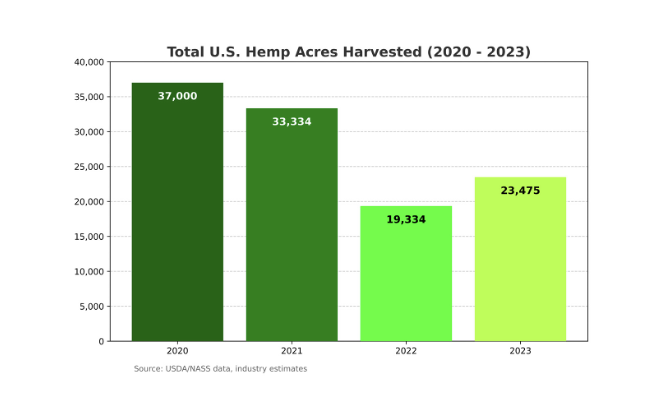
However, since 2020, the market for products made from hemp (defined as containing less than 0.3% THC) experienced a significant downturn, sparked by the pandemic and made worse by a lack of regulatory consistency over CBD and other hemp-derived cannabinoid compounds from the U.S. Food and Drug Administration (FDA) and state regulators. Investors pulled back. Brands did everything they could to survive; some didn’t. Overproduction during this time, too, led to steep drops in the price of hemp. As a result, hemp acreage plummeted from an estimated peak of 37,000 acres harvested in 2020 to a little more than 19,000 acres harvested in 2022.
Now, according to USDA’s hemp report, overall hemp acreage harvested in 2023 increased 21% to a total of 23,475 acres, signaling a potential turnaround in the market.
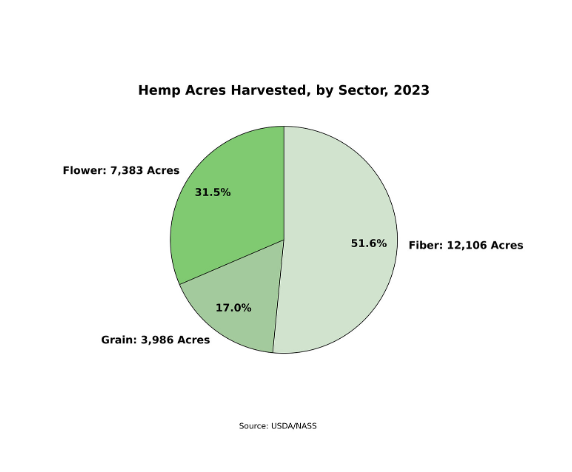
Hemp flowers for CBD and other hemp-derived cannabinoids -- including the intoxicating compounds Delta 8 and Delta 9 – dominated the market in 2023. While flower acreage remained relatively flat at approximately 7,000 acres in 2023, flower producers experienced an income gain of 35%, according to USDA data. Of the $291 million in market value for hemp in 2023, $241 million of that income came from hemp flowers. However, based on regulatory and safety concerns around Delta 8 and other hemp-derived psychoactive compounds, a number of industry observers feel this growth may be unsustainable, as lawmakers could severely limit the sale of these products.
Speaking of the hemp flower sector, economist Beau Whitney of Whitney Economics said, “It is quite possible that the cannabinoid industry has peaked. The excess inventories are mostly depleted and there is not enough acreage, in our view, to backfill with enough supply to sustain the level of sales experienced currently. This is a mistake by legislatures and regulators and now opens the door up for cheaper, but potentially lesser quality imports,” he cautioned.
Hemp grown for fiber – used in textiles and industrial applications – accounted for 52% of all hemp acreage harvested in 2023. While acreage grew, USDA reported that prices dropped and farmers brought in less income. However, says Whitney, “Hemp fiber is where we are forecasting significant growth in the short term, while cannabinoids and grains get sorted out. Hemp for plastics and automotive are already established in the global marketplace and are expanding in the United States. Hemp as a construction material is also increasing, but that growth has been somewhat sluggish in its initial ramp-up.”
Regarding hemp grown for food and grain, Whitney remarked, “The food industry is pretty steady. One major game changer would be FDA approval for hemp grains as an animal feed. It appears that the FDA is setting up unrealistic requirements for cannabinoid content in feed, so much so that consumers/animals would have less strict requirements for heavy metals and poisons than CBD content. There is a huge market for hemp grain internationally, but other supply chain issues and geopolitical tensions are impacting expansion efforts by U.S. hemp operators.”
According to USDA’s National Hemp Report, hemp grown for grain accounted for 17% of all hemp acreage harvested. Canada and China remain the world’s leading countries for hemp grain production, yet, as plant-based foods become more popular, U.S. growers stand to benefit from opportunities in growing hemp for food, as it is one of the richest plant-based sources of protein, essential fatty acids and other key nutrients.
“The use of hemp in automotive, pulp and paper (packaging), and building material applications are all increasing in the pace of growth,” Whitney added. “The major headwind is the narrative that hemp is a drug. The lack of awareness and education by policymakers on the potential of hemp is its limiting factor. Policymakers are using a sledgehammer instead of a scalpel when making hemp policy, and it’s having a ripple effect throughout the industry from an operator, investor and infrastructure perspective,” he said.
Stuck Between FDA and the MJ Industry
“There are two big battles going on in Washington, DC, right now. One is the hemp industry against the FDA. The other is hemp vs. marijuana,” observed Jonathan Miller, General Counsel of the U.S. Hemp Roundtable, the hemp trade’s leading advocacy and lobbying group.
“We’ve been trying to get the FDA to regulate CBD and other extracts. First, they said they were working on it and now they say they need congressional authority. It’s a game of pointing fingers – Congress says it needs guidance from FDA, and FDA says it needs direction from Congress, so we’ve got a stalemate. However, there has been a lot of congressional and public pressure on FDA to act, so that may be a reason why the agency is talking to us now,” Miller said. “We would love to see something resolved this year; there is talk of an interim step where Congress could potentially pass a law to validate existing state programs in the absence of consistent federal regulations. The Farm Bill may not happen until next year; meanwhile our efforts to find a vehicle for this compromise will continue.”
And, Miller said, “As always, we advise companies to act like they are being regulated by the FDA as a dietary supplement or a functional food and beverage product, and to operate within those regulations.”
In referring to competition with operators in the marijuana space, Miller said, “Regarding the marijuana industry, it is not monolithic, but there are a growing number of organizations that have made it their objective to kill the hemp industry as a means to capture competitive gain. This includes ATACH, the American Association for Hemp and Cannabis – though there are no hemp members – and the US Cannabis Council. Both have introduced plans that they would like to see in the Farm Bill to federally criminalize any hemp product that has any level of THC in it. That would criminalize all but CBD isolates,” he said.
“We are fighting both in the public eye and behind the scenes right now, and there’s a big battle going on in California in this regard. This is a threat we have to watch from the left flank. We are hopeful that any effort like this will die in Congress, but we are not banking on it; in fact, we are working very hard to prevent it. Just last week, we met with 55 different members of Congress and staff to discuss these issues and to present the hemp industry's position,” Miller added.
“All sectors of the hemp industry are growing, with the cannabinoid sector growing rapidly, to the point where it is outpacing the marijuana industry,” observed cannabis industry attorney Rod Kight of Kight Law. “The opportunities exist for nimble companies that are willing to take the time to navigate the rapidly evolving regulatory landscape and who can pivot as needed when regulations and markets change. I have hope that hemp can lead the path to true and comprehensive cannabis reform.”
FDA’s Position
When asked if the FDA could envision a scenario in which it would allow the sale of CBD as a dietary supplement without congressional action, Patrick Cournoyer, Senior Science Advisor with the FDA replied with the following:
“The FDA has concluded that the existing regulatory framework for dietary supplements is not appropriate for CBD. Given the available evidence, it is not apparent how CBD products could meet the safety standard for dietary supplements. For example, we have not found adequate evidence to determine how much CBD can be consumed, and for how long, before causing harm. Therefore, we do not intend to pursue rulemaking allowing the use of CBD in dietary supplements.”
Cournoyer’s office referred to FDA’s statement from January 2023, where the agency concluded that “existing regulatory frameworks for foods and supplements are not appropriate for cannabidiol,” and that it will work with Congress on “a new way forward.”
Added Cournoyer, “The FDA supports sound, scientifically based research into the medicinal uses of drug products containing cannabis or cannabis-derived compounds and will continue to work with companies interested in bringing safe, effective, and quality products to market.” Cournoyer referred to guidelines published on FDA’s webpage, “FDA and Cannabis: Research and Drug Approval Process.”
In addition to food, supplements and drugs intended for human consumption, FDA has regulatory oversight of animal feeds. Regarding the use of hemp in animal feed, an FDA spokesperson said, “After comprehensive review of data submitted by a sponsor, in January 2024, the FDA recommended to the Association of American Feed Control Officials (AAFCO) that a proposed ingredient definition for hemp seed meal in the feed of laying hens be included in the AAFCO Official Publication. The FDA has not reviewed any other submissions for the use of hemp seed or hemp seed derived ingredients in animal food.”
Wendy Mosher, VP of the Hemp Feed Coalition, told AgWeb in January 2024 that allowing hemp seed meal into feed mixes for laying hens marks the first hemp feed ingredient to get federal recommendation and interest by AAFCO. “You can’t have a commodity crop without a feed opportunity for that crop,” Mosher said.
In the absence of federal approval of hemp in animal feed, Texas legalized hempseed oil and hempseed meal for chickens and horses in 2023. Kentucky in 2022 allowed a limited amount of hempseed meal and hempseed oil as ingredients in the diets of layer, broiler, and breeder chickens. Montana legalized hemp or hemp-derived products in 2021 for “non-consumption animals,” i.e., pets, specialty pets, and horses, reported Hemp Benchmarks. However, in December 2023, New York Governor Kathy Hochul vetoed bills to allow hemp seed in animal feed, citing the need for more information.
While federal lawmakers and regulators move slowly in allowing the use of hemp in animal feed, USDA is providing grants to universities and others to research the potential use of hempseed, meal and biomass in animal feed. For example, researchers at Prairie View A&M University in Texas in 2023 received a $300,000 grant from USDA to explore hemp as an alternative grain in animal feed.
Building with Hemp
Building with hemp in the United States is increasing year over year, said Jean Lotus, Editor and Publisher of HempBuild Magazine. “Prices on building-grade hemp hurd remain high and the supply chain is neither complete, nor consistent. But hemp building in the United States is capturing the imaginations of developers and motivated owner-builders. Notable projects this year include a multi-unit tip-up hempcrete panel project in Newburyport, MA, and successful attainable hempcrete housing built by the Lower Sioux of Morton, MN,” she said.
“People may say hemp is dying, but it also recently received approval from the IRC (International Residential Codes) for the use of hempcrete in the U.S. for commercial construction,” noted James Johnson, Principal of JJGro in San Antonio, TX. Johnson, who discovered hemp’s healing properties while dealing with PTSD after 21 years of service in the U.S. Air Force, consults with hemp producers throughout the country. “Hemp is starting to be considered as part of the mix in mainstream commercial construction. It’s not going to replace traditional materials, but it will capture between 2% and 5% of the building construction space, Johnson predicted.
Lotus added that research in hemp building materials received significant funding in the past year, including $1.9 million from the U.S. Army; $1.5 million from the Department of Energy; and $1.1 million from the New York State Energy Resource and Development Authority (NYSERTA).
“Meanwhile, the regulatory environment for hempcrete's superior insulation and carbon sequestering properties is improving,” she said. “In April 2024, the U.S. Department of Energy released a roadmap to decarbonize the U.S. building industry. The report, Decarbonizing the U.S. Economy by 2050: A National Blueprint for the Buildings Sector, emphasized building with biogenic, regenerative materials. Hemp-lime and hemp-batt insulation perfectly fit the bill! With new companies developing carbon credits for hempcrete projects, there is more excitement and investment opportunity to come.”
“We are seeing increased interest in hemp across the board from consumers, universities, and large corporations wanting to utilize hemp as an input or ingredient. I think there's opportunities in every sector for savvy, smart business operators. While cannabinoids provide the biggest boom/bust potential, there are long term opportunities in the fiber and grain markets as the regulatory framework within those categories will eventually get to a point of any other commodity crop, for the most part,” said Morris Beegle.
“As to headwinds, it's still all political and bureaucratic,” Beegle added. “The industry needs to be unified in its voice to combat correctly, and I think we have made real progress the last few years with the vast majority of the ‘real’ industry aligning on messaging and action. We’re also seeing progress and persistence of the industry in delivering on the promise of hemp as an alternative resource to many of the world's current and future problems. The future is bright regardless of what some in the media, and some on social media, would like people to believe.”
Save the Date: NoCo Hemp Expo, Aug. 10-12, 2025, Estes Park, CO