
From Trust to Taste: Why Flavor Is the Next Frontier for Organic to Capture Gen Z and Millennials
By Steven Hoffman
For decades, the natural and organic products industry has built its foundation on a bedrock of trust, health, and environmental stewardship. Brands have painstakingly educated consumers on the benefits of avoiding synthetic pesticides, artificial flavors, and genetically modified organisms. That investment has paid off: today’s younger shoppers view organic as a non-negotiable standard for health and safety.
Yet, as the organic market matures and looks toward its next phase of growth, relying solely on a “free-from” health narrative may no longer be enough to capture the full potential of the Gen Z and Millennial consumer base.

Unsplash
According to new consumer perception research unveiled by the Organic Trade Association (OTA), the organic sector already definitively owns “health” & “trust” in the minds of younger shoppers. However, a significant white space remains in an area that dictates nearly every food purchase decision: taste and enjoyment.
In a webinar hosted on Oct. 21, 2026, OTA Co-CEO Tom Chapman, alongside organic marketing specialists Sandy Pfaff and Amanda Kauffmann of the creative agency Guru, presented the findings of a comprehensive study encompassing 1,025 Gen Z and Millennial consumers who already purchase organic products. The research aimed to decode which specific messaging territories—Taste & Enjoyment, Health & Wellness, or Climate & Sustainability—most effectively cut through the noise, resonate emotionally, and ultimately drive action at the retail shelf.
The findings presented in OTA’s 2026 Consumer Perception Research offer a roadmap for brand marketers, retailers, and executives in the natural products channel looking to optimize their merchandising, packaging, and communication strategies in a highly competitive grocery landscape.
A Strong Foundation and a Willingness to Pay
Before delving into the nuances of the messaging territories, the OTA research established a highly encouraging baseline regarding the current health of the organic sector. An impressive 90% of Gen Z and Millennial respondents are familiar with the USDA Organic seal, proving that industry-wide education campaigns, such as The Organic Center’s Seal Makes It Simple initiative, have successfully penetrated the market consciousness.
“We have an amazing asset,” said Pfaff during the presentation. “It’s got great equity, consumers trust it, it’s something that we can use, and it’s also something that we absolutely need to protect in terms of protecting the integrity and certainly maintaining that trust for consumers.”
When asked what they associate with organic, the respondents overwhelmingly pointed to the absence of undesirable inputs: no synthetic pesticides and fertilizers, no artificial flavors, and no artificial colors.
Crucially, this deep-seated trust translates into a remarkable resilience against price sensitivity—a vital metric in today’s inflationary grocery environment. The study revealed that 91% of respondents are willing to pay up to 10% more for organic products. Even more striking, 43% of these younger shoppers expressed a willingness to pay a premium of 20% or more.
“What was a huge thing for us is that consumers are recognizing the benefits, and they’re prioritizing the value of organic,” Pfaff noted. Kauffmann echoed this sentiment, emphasizing that while price is often perceived as the ultimate barrier to entry, strong messaging and clear value propositions can effectively overcome premium pricing hurdles for these demographics.
The Big Aha: The Taste Disconnect
To understand how to best communicate this value, the OTA research segmented the respondents and tested specific messaging narratives across three distinct territories. The results were decisive: Taste & Enjoyment emerged as the clear winner, preferred by 49% of the total audience—a preference that held identical across both Gen Z and Millennial demographics. Health & Wellness secured a 30% preference, while Climate & Sustainability trailed at roughly 20%.
While the preference for taste may seem intuitive for food products, the data revealed a critical disconnect in current organic marketing. When evaluating overall purchase drivers, price ranked first at 74%, immediately followed by taste at 73%. Nutritional information trailed significantly at 63%.
However, when consumers were asked to select their associations with organic food, less than half selected “great taste.”
“To me, this was the single biggest aha of the research,” Kauffmann explained. “Consumers associate the seal with the '‘free-from’ claims. ... Yet, less than 50% of them said taste was an organic association. There is a real opportunity for communication at the brand level to start associating taste with organic. It tastes better because it was made better.”
The research tested a “Taste & Enjoyment” narrative that framed organic not as a clinical health choice, but as a sensory upgrade: “Good food is one of life’s simplest pleasures, so why should any meal taste like a compromise? Organic starts with better soil and better farming, which is really just a long way of saying it tastes better, too.”
This messaging approach yielded exceptional results. Not only did it achieve the highest overall preference, but it also drove the highest purchase intent, with 89% of respondents stating they would be likely to purchase organic after reading the message.
Fascinatingly, the Taste & Enjoyment narrative actually outperformed the dedicated Health & Wellness messaging in making consumers feel “healthy.”
“They raised their hand and said, ‘Yes, I feel healthy after reading this taste and enjoyment message,’” Kauffmann noted, highlighting that the sensory message successfully validated the consumer’s desire to make a healthy choice without feeling clinical.
Pfaff summarized the opportunity: “Organic creates credibility ... but taste creates craveability. We want to create that sensory experience for consumers.”
Health & Wellness: Removing the ‘Homework’ of Eating Well
While taste presents the largest growth frontier, Health & Wellness remains the bedrock of the organic proposition. The research tested a health narrative focused on simplicity and stress reduction: “Somewhere along the way, eating well turned into homework. ... Organic takes all of that off of your plate and leaves you with just the good stuff. Made simple.”
This territory performed very strongly, driving an 86% purchase intent and a highly favorable 80% likelihood for consumers to swap conventional products for organic alternatives. The emotional drivers behind this messaging were overwhelmingly positive, eliciting feelings of confidence, health, reassurance, and hopefulness.
“The avoidance of [chemicals] made them feel very reassured. The simplicity of it as well,” Pfaff observed. “One of the things I took away from this is I think people felt they could relax.”
However, the testing also provided a masterclass in the nuances of brand tone. The researchers noted that when health messaging was pushed too far into “cheeky” or overly clever territory, it risked alienating the audience. For example, lines like “no PhD required” occasionally tipped the scale toward making organic feel exclusive or condescending. Similarly, messaging that implied parents were “tricking” their children with healthy food fell flat, as modern parents prefer to actively include their children in wellness education.
“Organic is not an exclusive club,” Pfaff emphasized. “Gen Z consumers and Millennials are telling us they want to be an everyday organic consumer. Making organic feel that much more relaxed, attainable, and normalizing it is a huge takeaway.”
Climate & Sustainability: The Danger of the Abstract
Perhaps the most surprising—and cautionary—findings emerged from the Climate & Sustainability territory. Despite Gen Z and Millennials being widely recognized as highly environmentally conscious generations, this messaging track performed the worst, securing only a 21% overall preference and driving the lowest willingness to pay a premium (63%).
The research revealed that when communicating environmental benefits, broad, abstract declarations about the global climate crisis fail to resonate at the point of purchase. In fact, messaging that referenced macro-level global warming (e.g., “it's hot enough already”was actively rejected by consumers, who found it overwhelming, lofty, or even condescending.
Instead, consumers demonstrated a strong preference for highly tangible, hyper-local environmental impacts. Words and concepts that scored exceptionally well in the green highlighted areas of the study included “healthy soil,” “birds,” and “bees.”
“I like really specific environmental positive impacts that are associated with organic because they feel tangible,” Kauffmann noted. “I can look out my window and see the soil, I can see the birds and the bees. That positive association with close-in impact was really resonant.”
Chapman provided further context on this dynamic, noting the inherent psychology of the grocery shopper. “Americans are selfish. We do care about the ‘me’ before the ‘we,’ and as we’re asked to spend more money, there is a desire for it to benefit ourselves,” he explained. “That’s why the taste and the health always rise so highly. ... If you’re going to unlock that climate messaging, making it as personal as possible is key.”
Kauffmann added a strategic tip for marketers: Climate and sustainability messaging should not be the primary entry point on the front of the package. Instead, it should be utilized further down the consumer funnel—such as on a brand's website or on Instagram—once the initial purchase drivers of taste and personal health have been satisfied.
Stop Saying ‘Zillennials’: Recognizing Generational Nuances
A key directive from the OTA presentation was a warning against treating Gen Z and Millennials as a monolithic bloc. While both groups strongly preferred the Taste & Enjoyment messaging, their underlying motivations differed significantly based on their current life stages.
When discussing the appeal of the “simplicity” message, Gen Z respondents (who are generally navigating early adulthood and independence) indicated they valued the ease of decoding labels to eat healthy for themselves. Millennials, who are more likely to be managing households and raising children, valued simplicity because it alleviated the stress of trying to understand how to eat healthy for their families.
“That’s two ways of saying the same thing, but it comes from a different emotional state,” Kauffmann pointed out. Recognizing these different life stages allows brands to deploy more segmented, resonant messaging rather than relying on a generalized “younger consumer” approach.
Strategic Takeaways for the Natural Channel
As the organic sector looks toward 2027 and beyond, the insights from OTA’s consumer perception research offer a clear, actionable mandate for brands, distributors, and retailers. Organic has successfully won the battle for trust and clean ingredients. The next era of growth requires integrating that trust into a joyful, sensory-rich culinary experience.
Brand marketers should internalize the following core strategies based on the data:
Lead With Taste and Craveability: Do not assume consumers know your organic product tastes great. Explicitly connect your high-quality, organic ingredients to a superior flavor profile. Make the food look and sound irresistible.
Keep It Attainable and Inclusive: Avoid marketing that makes organic feel like an elite, exclusive club. Use clear, simple language that normalizes organic food as a realistic everyday choice.
Ground Your Environmental Claims: Move away from abstract climate anxiety messaging on your packaging. Focus on tangible, understandable agricultural impacts like healthy soil, pollinator protection, and clean water.
Protect the Seal: The USDA Organic seal is an incredibly powerful, widely recognized asset that communicates health and safety instantaneously. Utilize it prominently, but pair it with engaging, consumer-centric copy.
Ultimately, capitalizing on this research requires a commitment to product excellence. As OTA’s Tom Chapman summarized, the organic seal provides unmatched brand equity, but the responsibility of delivering on the promise of taste lies squarely with the manufacturers.
“It is incumbent upon all of us to continue to put out delicious-tasting products with that organic seal, so that we don’t undermine this opportunity for our sector,” Chapman concluded.
By marrying the rigorous standards of organic agriculture with the universal joy of great-tasting food, the natural products industry is perfectly positioned to capture the hearts, minds, and wallets of the next generation of shoppers.
Steven Hoffman is Founder and Managing Director of Compass Natural Marketing, a communications and brand marketing agency serving the natural, organic, and regenerative products industries. He has written extensively on food policy, agricultural sustainability, and market trends for Presence News for over a decade.
The Organic Trade Association’s 2026 Consumer Perception Research report is available free to OTA members. Non-members can purchase the report. Visit here.
U.S. Organic Product Sales Near $70B; All-Organic Trade Show Set for 2025
By Steven Hoffman
Is it true that the growth rate in sales of certified organic bananas is now outpacing that of conventional bananas? According to the Organic Trade Association (OTA), the answer is yes.
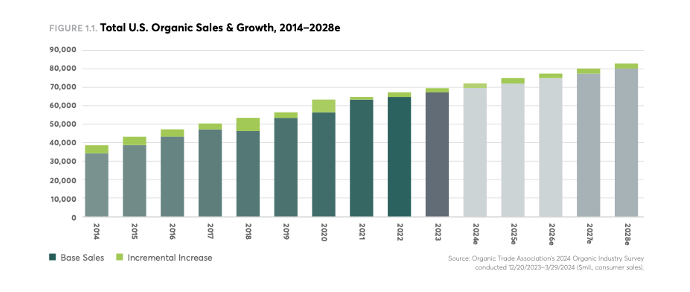
In fact, among an ever-expanding sea of certification seals in the retail sector, and despite inflation, the “Certified Organic” label continues to stand out for consumers who prioritize health, sustainability and clean-label products. So much so that U.S. sales of certified organic products grew 3.4% in 2023 to $69.7 billion, marking a new record for sales in the organic products industry.
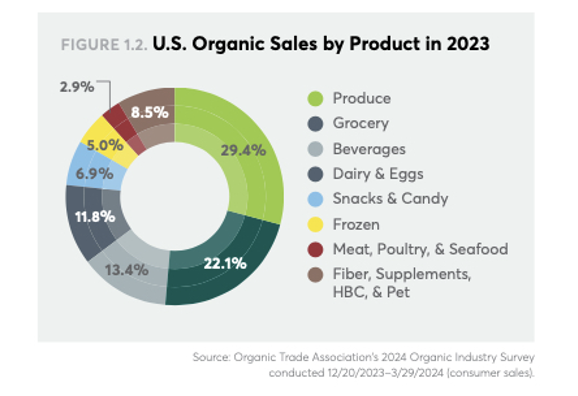
According to the OTA, which conducted the 2024 Organic Industry Survey in collaboration with Nutrition Business Journal, organic food sales in 2023 totaled $63.8 billion, and sales of organic non-food products reached $5.9 billion, with organic personal care products reporting the strongest increase in that category, with growth of 7% in 2023.
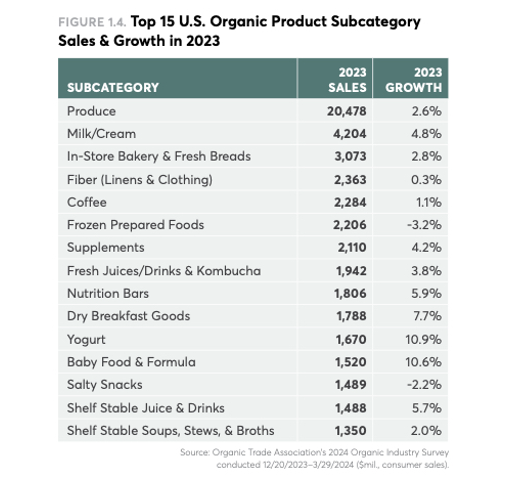
On the food side, fresh organic produce continues to dominate as the primary entry point for consumers, who are increasingly knowledgeable about the “Dirty Dozen” — those fruits and vegetables the Environmental Working Group has determined to contain the most synthetic pesticide residues. In 2023, sales of organic produce grew 2.6% to $20.5 billion. Top sellers included avocados, berries, apples, carrots and packaged salads. OTA also noted that, indeed, in 2023, organic bananas recorded greater sales growth than non-organic bananas.
Organic Baby Food Drives Growth in Grocery
The second biggest selling category in the organic sector in 2023 was grocery, comprising breads and grains, condiments, and packaged and prepared foods. Among a diverse group of sub-categories in grocery, three stood out as top performers: in-store bakery and fresh breads, with sales of $3.1 billion and growth of 3%; dry breakfast products, which were up 8% to $1.8 billion in sales; and organic baby food and formula, up an impressive 11% to record $1.5 billion in sales in 2023.
According to the OTA survey, 2023 also saw a surge in functional and non-alcoholic beverages, which helped drive beverages as the third largest category in organics, posting growth of 3.9% and sales of $9.4 billion. In addition to the emergence of organic “mocktails,” organic wine sales were up 2.5% to $377 million, and organic liquor and cocktails showed strength as an emerging category with growth of 13% and sales of $59 million in 2023.
Organic dairy and eggs, the fourth-largest category in the organic food market, based on OTA’s survey, is another entry point for consumers who want clean, ethical sources of protein with lower environmental impacts. In 2023, organic dairy and egg sales were up 5.5%, totaling $8.2 billion. According to OTA, organic dairy and eggs now account for more than 8% of all dairy and egg sales. Milk and cream sales were up nearly 5% to $4.2 billion. Also, the organic dairy alternative category grew almost 14% in 2023 to approximately $700 million.
Leading among organic non-food items were organic supplements, tracking 4% growth and sales of $2.1 billion in 2023. Organic fiber remains the largest segment of U.S. organic non-food product sales, representing 40%, or $2.4 billion, of non-food category sales. According to OTA, growth in organic fiber sales was essentially flat year over year, due to restricted supply chain issues more than lack of buyer interest.
Price Gap Is Narrowing Between Conventional and Organic
According to OTA Co-CEOs Matthew Dillon and Tom Chapman, the increase in overall dollar sales in the organic market in 2023 was driven more by price increases than unit sales as the organic industry recalibrated its supply chain and dealt with retail price increases as necessary. However, they pointed out, consumers increased their purchases of many organic products, and unit sales were up for nearly 40% of the products tracked in this year’s survey.
In addition, the survey indicated that prices for many non-organic products climbed at a faster rate than organic products, meaning that the price gap is narrowing between conventional and organic, which, says OTA, should fuel growth for organic products in the coming year.
“It is encouraging to see that organic is growing at basically the same rate as the total market. In the face of inflation and considering organic is already seen as a premium category, the current growth shows that consumers continue to choose organic amidst economic challenges and price increases. Although organic is now a maturing sector in the marketplace, we still have plenty of room to grow,” said Tom Chapman.
Matthew Dillon added that to achieve this growth, “It is essential to educate consumers that choosing organic is a straightforward way to tackle some of the greatest challenges we face. Whether it's accessing healthy foods, improving transparency in supply chains, mitigating climate change, supporting rural economic resilience, protecting natural resources, or realizing the multitude of other benefits, effectively communicating and delivering on these promises is the key to expanding organic’s share of our dinner plate.”
The future for organic is not without its challenges. However, Chapman and Dillon assert that more consumers are aware of the potential health benefits associated with organic foods. Many consumers, too, especially the Millennial and Gen Z generations, they point out, are increasingly conscious of the ethical implications of their food choices. They are looking for products that align with their values, such as animal welfare, fair trade, and support for organic farmers. That means seeking out products with the USDA certified organic seal on the label.
OTA Members can download the full report here. A summary is available here.
Dedicated All-Organic U.S. Trade Show Announced
Since 1991, people from all over the world have attended, BioFach, the world’s only dedicated, all-organic trade show, held each year in Nuremberg, Germany. Now, targeting the world’s largest market for organic products, the producer of BioFach has announced it will host its first standalone, all-organic trade show in the U.S.
Dubbed BioFach America, the event will take place on June 2-4, 2025, in Atlanta.
“With BioFach America, we will host a purely organic trade show in the US. The whole organic value chain will be covered: from organic farming to retail,” said NürnbergMesse, producer of the event. According to the producer, every product presented at BioFach America must be USDA certified organic or carry an organic certification from an IFOAM Organics International accredited organization. For cosmetics, certifications such as COSMOS or Ecocert, are accepted.
In an interview with Organic Insider, Bill Ingwersen, CEO of NürnbergMesse North America, said, “BioFach America always had a presence, or section, at Natural Products Expo East, and last year in Philadelphia, we brought in 47 companies from around the world. With that show being canceled, it forced us to really ask the question: are people getting what they need at other shows or is there a true need for an organic one? We concluded that there was, in fact, a real need for a dedicated, all-organic platform in the U.S.”
When asked why Atlanta was chosen as the location for the inaugural event, Ingwersen told Organic Insider, “Since this is a U.S. show and not a regional one, people will have to travel, regardless of which city we chose. After many conversations with industry executives, it became clear that we had to make it an affordable show for everyone, including farmers. Atlanta has the world’s largest airport, has an ample supply of low-cost hotel rooms and is a very energetic, accessible city that has great infrastructure. In addition, it can support our growth as we move forward. Also, being able to serve an organic lunch to our attendees was a real hot button topic. All the catering coming out of the Atlanta Convention Center will be organic for the show, and if a city could not guarantee this, that was an immediate disqualification.”
Learn more about BioFach America here.