
GMOs in the News: 2 Million Rally Against Monsanto
The March Against Monsanto held on May 25 drew more than 2 million people to protest chemical giant Monsanto and the genetically engineered seeds it produces.

More than 2 Million People Rally in 52 Countries to Protest GMO Giant Monsanto
From a single Facebook page started in February, the March Against Monsanto held on May 25 drew more than 2 million people in 52 countries and 436 cities to protest chemical giant Monsanto and the genetically engineered seeds it produces. "If I had gotten 3,000 people to join me, I would have considered that a success," protest organizer Tami Canal told USA Today. "It was empowering and inspiring to see so many people, from different walks of life, put aside their differences and come together," she said. The group plans to harness the success of the event to continue its anti-GMO cause. "We will continue until Monsanto complies with consumer demand. They are poisoning our children, poisoning our planet," she said. "If we don't act, who's going to?" Protests were held in Los Angeles, Portland, OR, Buenos Aires, Argentina, Amsterdam in the Netherlands, and elsewhere around the globe. “As a single company, Monsanto is the tip of the iceberg representing the threat that unchecked corporate power has in corrupting our democratic institutions, driving family farmers off the land, threatening human health and contaminating our environment,” said Dave Murphy, executive director of Food Democracy Now, in a May 28 commentary in the Huffington Post.
Washington State Yes on 522 Launches GMO Labeling Campaign into Full Gear
With a new website, www.yeson522.com, the recent hiring of professional campaign management staff, and $1.1 million in contributions received, the Yes on 522 campaign to label GMO foods in Washington State is swinging into full gear and is appealing to natural and organic products business leaders to help fund what many experts say is the best opportunity to achieve mandatory GMO labeling in 2013. At a recent press conference, Rep. Jared Polis (D-CO), co-sponsor of the Boxer-DeFazio federal GMO labeling bill, said it is critically important to support the Washington State initiative to give greater weight to the Washington, DC, federal GMO labeling efforts, given biotech’s strong lobbying presence in the nation’s capitol. In a letter to donors, Yes on 522 finance chair David Bronner of Dr. Bronner’s reported that the campaign has launched an ambitious grassroots outreach program called “Kitchen Conversations,” in which advocates can receive a kit containing information to host informal gatherings among voters, and is rolling out a “Dining Out for 522” chef’s fundraising campaign. The campaign scheduled its first stakeholder meeting for May 31 in Seattle. Presence Marketing/Dynamic Presence is among the leading supporters of the Yes on 522 GMO labeling bill. Steven Hoffman of Compass Natural Marketing is helping lead fundraising efforts and outreach to natural and organic products industry leaders. For information and to contribute, visit www.yeson522.com.
Whole Foods Market Endorses Washington State’s Yes on 522 GMO Labeling Bill Joining a coalition of leading Washington State-based retailers including PCC Natural Markets and Marlene’s Natural Foods Market and Delis, among others, Whole Foods Market on April 25 announced its support for the Yes on 522 (www.yeson522.com) campaign to label genetically engineered, or GMO, foods. In support of Yes on 522, Whole Foods Market launched a grassroots effort, Will Vote for Food (www.willvoteforfood.com) to engage consumers and build support for the ballot initiative. “This issue is about transparency and the consumer’s right to make informed decisions,” said Joe Rogoff, president of Whole Foods Market’s Pacific Northwest region. “We believe that growers using genetically modified seed, and producers using the products grown from those seeds, have an obligation to share that information with their public. And the price paid by the food industry for relabeling is a pittance compared to the distrust that increasingly results from their concealment. We support Yes on 522. At Whole Foods Market, we will vote for food.”
New Leaf Markets Require GMO Labeling; Terra Organica Labeling GMO Products Following in the footsteps of Whole Foods Market, Santa Cruz, CA-based natural retailer New Leaf Community Markets announced it would require labeling of foods containing GMO ingredients in its seven stores by 2018. New Leaf was an early retail member of the Non-GMO Project and a strong supporter of California’s Prop 37 2012 GMO labeling measure, which was defeated by a narrow margin. New Leaf co-owner Scott Roseman commended Whole Foods for taking the lead on the labeling issue and said the five-year deadline gives manufacturers time to update packaging or research alternative ingredients. In related news, Stephen Trinkaus, owner of Terra Organica in Bellingham, WA, asked his customers what they wanted in terms of GMO labeling. The choices were: do nothing, label products that contain GMO ingredients, or get rid of the items altogether. Customers overwhelmingly chose labels, so Trinkaus began labeling products in the store that are likely to contain GMO ingredients. “I thought it would be simpler than it is,” Trinkaus told the Seattle Times. He wants customers to know if a manufacturer is working to replace GMO ingredients with non-GMO alternatives – many are after Whole Foods Market’s announcement to require GMO labeling in 2018, he said – and is revamping labels in his store to display more complex information.
Vermont, Maine Advance GMO Labeling Legislation
On May 14, despite concerns over lawsuit threats from the biotech industry, Maine's House Agriculture Committee passed a GMO labeling measure on an 8-3 vote. The bill, LD 718, offered by Rep. Lance Harvell (R-Farmington) wouldn’t go into full effect until 2018, and only after four of the nine northeastern states approve similar laws. However, they may be one step closer to realizing that goal: on May 10, the Vermont House passed a mandatory GMO labeling bill by an overwhelming 107-37 vote, again, despite massive lobbying efforts by the GMO biotech industry and threats to sue the state. If approved by the state Senate and signed by the governor, the bill, H 112, could make Vermont the first state in the nation to require labeling of genetically modified foods. But the measure likely wouldn’t go into effect for two years, and it would not affect meat, milk or eggs from animals that were fed or treated with genetically engineered substances, including GMO corn and the rBGH cattle hormone. While GMO labeling is not required in the U.S., according to the Center for Food Safety, 64 countries, including China, Russia and all EU nations currently have GMO labeling laws in place.
Monsanto CEO Blames Social Media for “Elitist” Anti-GMO Sentiments
Citizens who are against genetically modified foods or are calling for mandatory labeling of GMO foods are guilty of “elitism” that is fanned by social media, and they fail to consider the needs of the rest of the world, said Monsanto CEO Hugh Grant in a May 15 interview with Bloomberg Press. “This place is getting busier and more crowded,” Grant said. “As long as you’ve got money in your back pocket and you drive your station wagon to the supermarket on weekends, then it’s out of sight, out of mind, so far.” The advent of social media helps explain why many people in the U.S. have come to oppose genetically engineered crops in recent years, Grant told Bloomberg. Grant feels that GMOs are the answer to feeding the world’s growing population, while opponents point to increased use of toxic synthetic pesticides associated with GMO agriculture, the fact the farmers can no longer save seed if they are practicing GMO farming, the potential contribution of GMO farming to global climate change, and peer-reviewed studies that warn of risks to human, animal and environmental health. In related news, executives from Monsanto, DuPont and Dow Chemical – among the world’s largest producers of GMO crops and pesticides, and owners of a significant majority of the world’s seed companies – told Reuters that they are developing a national promotional campaign aimed at turning the tide on growing public sentiment against GMO crops. With GMO labeling measures before the federal government and more than 20 states, the biotech firms seek to limit the spread of such initiatives, which the companies say would only confuse consumers and upset the food manufacturing industry, according to Reuters. The biotech industry is still working out details of their marketing campaign, but it will likely have a large social media component, the company executives said.
Supreme Court Rules for Monsanto in Seed Case Rejecting an Indiana farmer’s argument that his planting of seeds he had bought second-hand did not violate Monsanto’s GMO seed patent, the U.S. Supreme Court on May 12 ruled unanimously that farmers must pay Monsanto each time they plant the company’s genetically engineered soybeans. Farmer Vernon Hugh Bowman asserted that because the company’s herbicide-resistant, Roundup Ready soybeans replicate themselves, he was not violating the company’s patent by planting progeny seeds he had purchased elsewhere. However, the justices unanimously rejected that claim, with Justice Elena Kagan writing there is no such “seeds-are-special” exception to the law. But Kagan warned that the Monsanto decision was a limited one and did not address every issue involving a self-replicating product. The court ordered Bowman, a conventional farmer, to pay nearly $85,000 in damages to Monsanto. The Supreme Court's decision implies that Monsanto has the legal right to stop farmers from saving seeds from patented genetically modified crops one season, and plant them the next season.
UNPA Hosts GMO Symposium for Supplement Manufacturers Despite what happens on a legislative and regulatory front, what is certain is that consumers want GMO labeling, and Whole Foods Market is requiring GMO transparency from all of its vendors by 2018, said Loren Israelsen, Executive Director of the United Natural Products Association (UNPA), a Salt Lake-based trade association serving the natural and nutritional products industry. To help companies understand the challenges and implications of GMOs in nutritional supplements and food products and to prepare for GMO labeling, UNPA hosted on May 23 a day-long symposium, “The Non-GMO Future: How to Source, Test, Label and Market Food and Supplement Ingredients.” “If you sell into Whole Foods [Market] or aspire to sell to them, you need to understand the GMO supply chain,” said Israelsen in a recent interview with Nutra-Ingredients. “We sense that the issue is substantially more significant than dietary supplements companies think,” he said. Speakers at the symposium included Courtney Pineau, assistant director of Non-GMO Project; Robert Craven, CEO, FoodState/Megafood; John Fagan, Ph.D., founder of Global ID; Sandy Kepler, CEO of Foodchain Global Advisors; Adam Ismail, executive director of GOED; Steven Hoffman, managing director of Compass Natural Marketing; and Ken Roseboro, editor and publisher of The Organic & Non-GMO Report. For info visit www.unpa.com.
After Being Rejected by Consumers, Will GMO Spuds Make a Comeback? While the FDA weighs approval of GMO salmon, a dozen years after Monsanto ditched its GMO potato after disappointing sales, an Idaho company, J.R. Simplot, asked FDA in mid-May to approve five varieties of GMO potatoes. The varieties have been genetically engineered to avoid black spots and designed to have less acrylamide, a naturally occurring but potentially toxic chemical. Simplot, according to MSN News, sells potatoes to McDonald’s for its French fries, and McDonald’s rejects potatoes with black spots. The FDA is also reviewing the “Arctic” apple, genetically engineered by Canada-based Okanagan Specialty Fruits to resist turning brown when cut. While Simplot said 20 field trials demonstrate that GMO potatoes are virtually identical to their unmodified cousins, Bill Freese, senior policy analyst with Washington, DC-based Center for Food Safety, said that genetic engineering is a “noisy, unpredictable process,” where the best-intentioned genome tinkering could be accompanied by unforeseen effects on human health and the environment. "The biotech approach is to change the food on a genetic level in quite frankly risky ways with inadequate regulation to adapt a crop to an industrial food system that's really unhealthy in so many ways," he said.
Market Research: Fruit Flies Say Organic is Better
The study, conducted by Dallas middle-school student Ria Chhabra, tracked the effects of organic and conventional diets on the health of fruit flies.
You may have heard, of all things, about recent research related to organic food and fruit flies published in the respected scientific journal Plos One. The study, conducted by Dallas middle-school student Ria Chhabra, tracked the effects of organic and conventional diets on the health of fruit flies. By nearly every measure, including fertility, stress resistance and longevity, flies that fed on organic bananas and potatoes fared better than those who dined on conventionally raised produce, according to the New York Times. The study, which earned 16-year-old Chhabra top honors in a national science competition, provided “evidence that organically raised food may provide animals with tangible benefits to overall health.”
U.S. families, too, are flocking to organic foods, with 81% of families reporting that they purchase organic at least sometimes, says the Organic Trade Association (OTA) in its survey, “U.S. Families’ Organic Attitudes and Beliefs Study,” conducted in January 2013. Nearly half (48%) of those who purchase organic foods said they do so because “they are healthier for me and my children.” Among the top reasons to purchase organic are the desire to avoid toxic and persistent pesticides and fertilizers, antibiotics and growth hormones, and genetically modified organisms or GMOs. More than four in 10 parents (42%) said their trust in organic products increased, vs. 32% who indicated this point of view a year ago. “More and more parents choose organic foods primarily because of their desire to provide healthful options for their children,” said Christine Bushway, Executive Director of OTA.
However, in a March 2013 Harris Interactive poll of 2,276 U.S. adults, more than half (59%) agreed that labeling food or other products as organic is just an excuse to charge more. "What surprised us most was that while Americans are showing more concern for the environment, they aren't necessarily willing to pay more to do anything about it," said Mike de Vere, Harris president. "While Americans feel better about the economy, many are wary of the 'greenwashing' concept that gives companies a chance to cash in on consumers who want to help the planet but are confused by all the eco-friendly jargon." Manufacturers who convey the true value of organic while offering a fair price will be better positioned to win over this skeptical consumer.
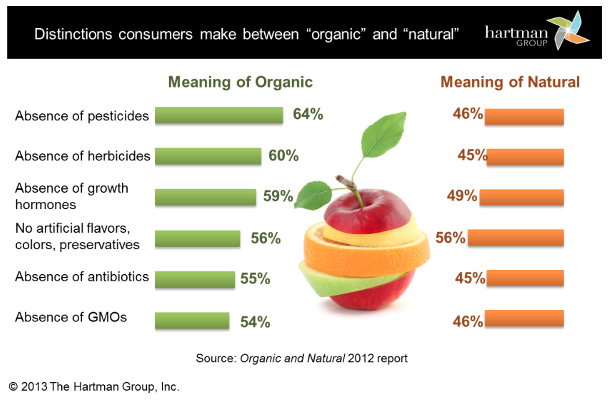
Similarly, the Hartman Group discovered in its 2012 Organic and Natural Report that only slightly more than half (54%) of consumers surveyed believe “organic” means non-GMO. While GMOs are prohibited in certified organic production, the proliferation of non-GMO seals, often appearing next to the USDA Organic seal on packaging, may have diluted the consumer’s perception that organic also means non-GMO.
However, OTA reports that U.S. families are becoming increasingly aware of the presence of unlabeled genetically modified organisms (GMOs) in foods in the marketplace, with one-third (32%) of U.S. households turning to organic to avoid GMOs.
Graphic: Courtesy of The Hartman Group, www.harman-group.com.
World’s First Pressed Organic Juice Directory Launches

For Immediate Release
Contact: Megan Shockney, Chloette PR, megan@chloettepr.com, (858) 442-3492.
World’s First Pressed Organic Juice Directory Launches
Organic Food Expert Max Goldberg Curates New Directory of Stores Across the Country Selling Pressed Organic Juice; Plus Comprehensive News on the Industry
April 30, 2013 – New York, NY – With the explosion in the popularity of pressed juice, one of the country’s most widely read organic food bloggers and experts, Max Goldberg of Living Maxwell, has debuted the Pressed Organic Juice Directory, the first-of-its-kind directory of locations around the world selling pressed organic juice.
“The Pressed Organic Juice Directory developed out of a need that was not being met in the marketplace,” said Goldberg. “As a huge pressed juice fan and someone who has been eating close to 100 percent organic since 2001, I wanted to know where I could get pressed organic juice whenever I traveled. Yet, after lots of online research, the results were very incomplete. Some locations were fully organic; some places used organic ‘whenever possible’; and some used a centrifugal juicer, while others used a Norwalk or similar type of hydraulic press. What I wanted was a site that would clear through all of the clutter and give me exactly what I was looking for – places that offered pressed organic juice.”
Pressed juice has exploded in popularity for two primary reasons. First, it is a superior extraction method. Independent tests show that a hydraulic press can extract three to five times more minerals and nutrients than a centrifugal juicer. Second, hydraulic press juicers do not oxidize nearly as fast. Centrifugal juicers use a tremendous amount of heat, which causes mineral, enzyme and vitamin degradation. Since the amount of heat used in a hydraulic juice press is very minimal, the oxidation is not nearly as severe.
Goldberg’s Pressed Organic Juice Directory only lists locations that sell pressed organic juice which offer a minimum of a green juice. Additionally, the juice must be either USDA certified organic or comprised of 95 percent organic ingredients, the same standard established by the USDA.
Key Attributes of the Pressed Organic Juice Directory
Comprehensive site covering pressed organic juice industry news, new products and store openings, store profiles and interviews with well-known industry figures.
Nearly 700 listings from five countries, with new locations added every day.
Curated by an expert with domain expertise in the organic field; every single entry is personally vetted by Goldberg.
Not just any juice bar is listed – there are clear requirements: organic, pressed, and must have a minimum of a pressed organic green juice.
Includes a directory of organic pressed juice companies that will ship juice via overnight delivery to any location in the U.S. Individual store profiles with commentary by Goldberg about the location and their juice, as well as a variety of photos of their juice and the individual store (available currently for select locations, more profiles to be added).
iPhone app is in development, and the site currently works on all mobile and tablet devices.
“Consumers continue to drink juice and eat foods that are conventionally-grown and sprayed with toxic pesticides. After extensive personal research and reading reports about the effects of these pesticides, I felt it was of paramount importance to eliminate non-organic foods from my own diet and that is why I chose to focus on organic juice for this directory.”
Goldberg has personally been eating organic for more than 10 years and focused on organic pressed juice because of the toxic pesticides used on non-organic foods. With 41% of Americans expected to get cancer, the President’s Cancer Panel recommends that people consume food grown, to the extent possible, “without the use of pesticides.” Organic regulations strictly prohibit the use of toxic chemicals – synthetic pesticides, insecticides and herbicides, while conventionally-grown food allows them.
“I developed the Pressed Organic Juice Directory because it was something that I wanted to have for myself, and I knew so many others that were looking for this kind of information as well,” continued Goldberg. “My main goal, however, is for the Directory to serve as a vehicle to increase awareness about the importance of organic – the healthiest food that we can be putting into our bodies.”
With the launch of the Pressed Organic Juice Directory, BluePrint has come on board as the site’s initial sponsor.
“Needless to say, I’m thrilled to have BluePrint affiliated with the Pressed Organic Juice Directory,” said Goldberg. “Not only is the company a true pioneer in the pressed organic juice world, but founders Erica Huss and Zoe Sakoutis have a serious commitment to organic, something of utmost importance to me. All of BluePrint’s pressed juices are USDA certified organic, and the company was a major sponsor of our New York City fundraiser last year for Proposition 37, California’s ballot initiative to label GMOs.”
About Max Goldberg
Founder of Living Maxwell (www.livingmaxwell.com) and described by The New York Times as an "organic sensation", Max Goldberg is one of the most widely read organic food bloggers in the country today. He has been profiled in The New York Times, The Huffington Post, CNN, Veria Living, and numerous other media outlets.
An organic food activist, partner of the Just Label It! campaign, and speaker at industry trade shows, Max runs the Organic Food Industry Group on LinkedIn, where his weekly curated email is read by thousands of organic food CEOs, founders and executives from all over the world.
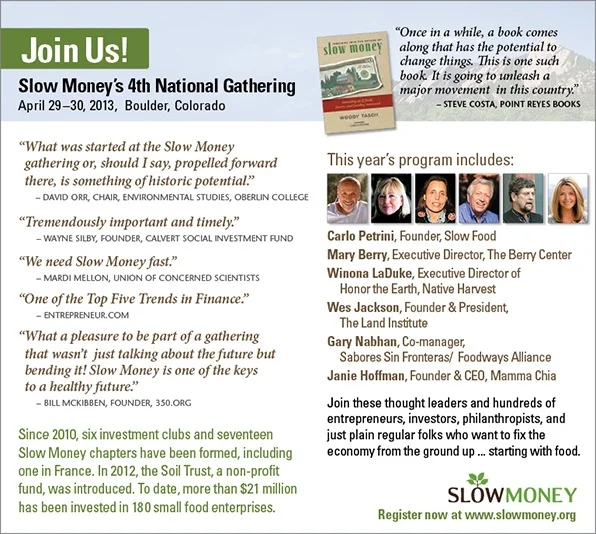
Slow Money | Sustainable Economy: National Gathering in Boulder, April 29-30

“What a pleasure to be part of a gathering
that wasn't just talking about the future but bending it!
Slow Money is one of the keys to a healthy future.”
– Bill McKibben, Founder of 350.org
“One of the Top 5 Trends in Finance.”
– Entrepreneur.com
Slow Money Invests in Small Food Business
Since its inception in 2008, Slow Money has invested more than $21 million in 180 small food and sustainable farming enterprises. Learn what Slow Money can do for your business, and how your investment dollars can make a big difference.
Click here for more information and to register.
Communications on behalf of Slow Money by Compass Natural Marketing, Boulder, CO
www.compassnaturalmarketing.com | info@compassnaturalmarketing.com
NFC Adds GMO Guard to its Growing Roster of Certification Programs
For Immediate Release
Contact:
Steven Hoffman, steve@compassnatural.com, tel 303.807.1042.
Reuven Flamer, nfccertification@gmail.com, tel 888.422.4632.
Spring Valley, NY, March 28, 2013 – In response to the natural food industry's – and the consumer’s – growing concern with regard to genetically modified organisms (GMOs) "cropping" up in the public food supply, Natural Food Certifiers (NFC) has added a new component to its growing roster of product supervision and certification programs: the NFC “GMO Guard” Verification Program.
"We are very proud to introduce and offer the GMO Guard Program," said NFC Director Rabbi Reuven Flamer. "It's a logical extension of the programs that NFC already offers, and one that is so timely and sought-after in the natural and organic food market today."
The GMO Guard verification program joins the impressive array of NFC's Food Certification programs, which include USDA Organic certification, Kosher Certification (under the “Apple K” label), Vegan Certification, and Gluten Guard, a gluten-free assurance program. By offering a portfolio of certification programs valued by natural and organic products consumers, NFC offers cost-effective, simultaneous, turnkey solutions for food manufacturers seeking to assure their customers of certified organic, non-GMO, kosher, vegan and/or gluten-free products.
"GMOs are the number one growing concern among health-conscious consumers and for businesses in the natural and organic food markets, as well as in the conventional food industry," explained Rabbi Flamer. "Recent studies show that GMOs may cause various kinds of health problems from digestive disturbances to food allergies, and that GMOs require more herbicides, which is really the opposite reason why GMOs were touted to be so environmentally helpful in the first place," he added. "For all of the many reasons that GMOs raise a red flag, physical and environmental, consumers simply don't want them in their foods, and our clients want to accommodate their customers."
In order to assess a new product for GMO Guard verification, NFC performs an intake -- commitment and cost free -- to analyze the product and will then advise clients of the next steps and costs to obtaining a seal. The process may include, but is not limited to, a request and review of the ingredient deck including country of origin and certificate of analysis, as well as inspection of manufacturing facilities.
Leading natural and organic products retailers such as Whole Foods Market are seeing growing demand for products that don’t use genetically engineered ingredients. Products that have a non-GMO assurance seal are seeing sales increases of 15 percent to 30 percent, according to Whole Foods Market President A.C. Gallo.
About Natural Food Certifiers
NFC Founder and President (Rabbi) Reuven Flamer began a career in the natural products industry in 1976 when he founded "Le Centre," the first natural food co-operative in the Laurentian Mountains, outside of Montreal, Quebec. He launched NFC in 1997. In 2002, NFC became the first Rabbinic-led kosher agency to certify organic under the USDA National Organic Program. "Our company is based on the principle that, 'If it’s kosher, its good for the soul; if it's naturally healthy, it’s good for the body; and each should have the other,'" explained Flamer. For more information, please email nfccertification@gmail.com, visit www.nfccertification.info, or call Rabbi Flamer at (914) 319-9040.
NFC is offering special rates to new and existing customers, who can easily add the NFC GMO Guard Verification Program to their existing NFC certification programs for their products.
Communications by Compass Natural Marketing
info@compassnatural.com | www.compassnatural.com | 303.807.1042
Video: Women Leading Green - Top Sustainability Entrepreneurs
At the Epicenter, a CO-based speaker series featured on February 12, 2013, three women leaders in green business.
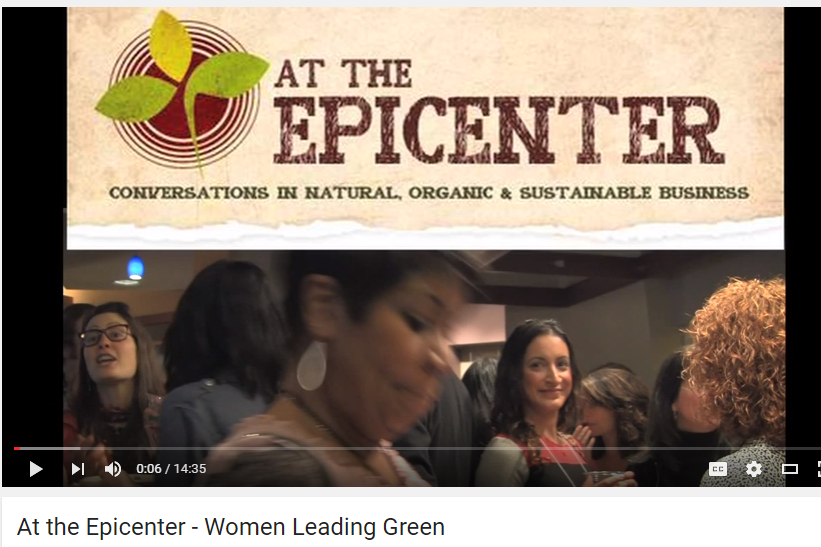
At the Epicenter, a popular Boulder, CO-based speaker series featuring business and thought leaders in natural and organic products and sustainability, featured on February 12, 2013, three women leaders in green business, including Hunter Lovins of Natural Capitalism Solutions, Kim Coupounas, Co-founder of Go-Lite, and Brook Eddy, CEO of Bhakti Chai. Moderated by Seleyn DeYarus, CEO of At the Epicenter is produced by Compass Natural Marketing
View video highlights from this informative and entertaining discussion. Plus, speaker bios are below. http://youtu.be/mpuhhaaBDv4?t=5s
Hunter Lovins, Founder, Natural Capitalism Solutions Trained as a sociologist and lawyer, Hunter Lovins is a world-renowned author, President and founder of Natural Capitalism Solutions, a professor of sustainable business management, and a sought-after expert in sustainable solutions for businesses, corporations and governments worldwide. Based in Boulder, Hunter was named Time Magazine 2000 Hero of the Planet and in 2009 Newsweek named her a "Green Business Icon."
Kim Coupounas, Co-founder and Chief Sustainability Officer, GoLite Kim Coupounas is Co-founder and Chief Sustainability Officer of GoLite, the premier global manufacturer of lightweight, high performance, socially responsible apparel and equipment designed for outdoor athletes. Kim also served as the company's CEO until 2008, and is former Chair of the Outdoor Industry Association (OIA), representing the $646 billion active outdoor recreation industry. Kim also served on OIA's Sustainability Working Group.
Brook Eddy, Founder and CEO, Bhakti Chai With a degree in Social Policy, Brook Eddy traveled to India in 2002, where she discovered masala chai tea. Back in the U.S., she created her own recipe, which was so well received by family and friends that she founded Bhakti Chai in 2006. Today, Bhakti is emerging as a brand leader in the organic, fair trade tea and ready to drink categories. The Bhakti philosophy - devotion through social action - continues to drive the company's business practices.
Seleyn DeYarus, CEO, Best Organics Inc. Seleyn DeYarus is Co-founder of At the Epicenter and CEO of Best Organics Inc., an organic and sustainable brands promotion company and provider of America's Best Organics gift basket collections. Seleyn is a former environmental consultant for international business strategist Booz Allen Hamilton, and she served as an intern in the White House's Speech Writers Research Office, where she was personally selected by President Reagan himself.
Video produced by Howard Zaremba, Boulder Valley Media Alliance, BV Channel 22.
Video: GMO Labeling - We Have a Right to Know
This 60-second video, produced by Boulder-based Whizzbang Studios and Compass Natural Marketing, made its debut at a GMO labeling seminar and press conference held on March 7, 2013.
This 60-second video, produced by Boulder-based Whizzbang Studios and Compass Natural Marketing, made its debut at Natural Products Expo West, the world's largest natural and organic products trade exhibition, at a GMO labeling seminar and press conference held on March 7, 2013. http://youtu.be/biuMH9L1-tU
With GMO labeling and consumer transparency a key issue at this year's trade show, the seminar, moderated by Compass Natural Marketing Managing Director Steve Hoffman, was standing room only. Featured speakers included public health attorney Michele Simon; Ken Cook, president of Environmental Working Group; Lori Lively, Washington State I-522 campaign executive committee member and education director for Marlene's Market and Deli; Gary Hirhberg, Chair of Stonyfield Farm and founder of Just Label It; Jessica Lundberg of Lundberg Family Farms; and David Bronner, CEO of Dr. Bronne'rs and I-522 campaign executive committee member.
For more information on the Washington State I-522 People's Right to Know Genetically Engineered Food Labeling Act, visit www.labelitwa.org.
MetaBrand Makes Trade Show Debut at Natural Products Expo West
MetaBrand - the leading "concept-to-market" turnkey solutions provider for emerging natural and organic beverage and supplements brand at Expo West

For Immediate Release
Contact:
Steven Hoffman, Compass Natural, tel 303.807.1042, steve@compassnatural.com
Eric Schnell, MetaBrand, tel 888.611.5573, info@metabrandcorp.com
MetaBrand Makes Trade Show Debut at Natural Products Expo West
Visit MetaBrand - the leading "concept-to-market" turnkey solutions provider for emerging natural and organic beverage and supplements brands - at Booth #7213 in the "Next" New Products Pavilion at Natural Products Expo West, the world's largest natural and organic products trade exhibition, March 8-10.
March 7, 2013 – Edison, NJ – Turnkey beverage and supplement companyMetaBrand is off to a fast start. Founded in 2012, the "concept-to-market" solutions provider has contributed to the growth of more than a dozen natural product brands in various capacities.
Company representatives, including Founder and CEO Eric Schnell, will be on hand at Natural Products Expo West - the world's largest natural and organic products trade exhibition - to showcase MetaBrand’s capabilities and meet with prospective clients.
Much of the early success for MetaBrand can be attributed to its ability to address the specific needs of each unique client. Unlike more rigidly structured organizations, MetaBrand is able to leverage the broad, multi-disciplinary expertise of a team of 35 industry-veteran advisors. Because of this unique model, MetaBrand can provide unmatched workscope and pricing flexibility to its growing client roster.
This flexibility is demonstrated in two distinct projects that MetaBrand is currently working on; Runa Tea and FitPro Real Milk Protein. The former, a brand of organic ready-to-drink (RTD) Guayusa teas, utilizes MetaBrand’s formulation, extraction, and packaging technologies. The latter, a brand of all-natural RTD protein shakes, leans on MetaBrand for branding, marketing, and sales/distribution strategy. Both rely on the broad capabilities of MetaBrand, only in very distinct ways.
Also paramount to MetaBrand’s success is the recent addition of three key personnel; General Manager Janis Grover, Technical Director Kathryn Deibler, Ph.D, and Director of Operations Michael Fougere. Together, the trio brings more than 60 years of collective industry experience in the areas of brand management, food science, flavor research, manufacturing, and distribution.
“MetaBrand has been a success for two main reasons,” says Schnell. “First, we have assembled an unbelievably talented group of industry advisors. Second, our structure allows for à la carte services based upon client needs. No other company that I am aware of offers such a dynamic combination.”
MetaBrand will make its national trade show debut at Natural Products Expo West at the Anaheim Convention Center in Anaheim, California, March 8-10, 2013. Interested attendees should visit Booth #7213. For more information on MetaBrand, please visitwww.metabrandcorp.com.=
About Metabrand
Created by natural products industry veteran and Steaz Teas Co-founder Eric Schnell, MetaBrand, based in Edison, NJ, offers turnkey “R&D to retail” services to start-up and early-stage natural and organic beverage and supplement brands, including product formulation and development, manufacturing, distribution, and sales, marketing and promotional strategies. With a team of 35 advisors and long-standing industry relationships, MetaBrand helps companies quickly and efficiently develop winning formulations for natural product concepts that are on-trend and efficacious, regulation compliant, and scalable. For more information on MetaBrand, visitwww.metabrandcorp.com, info@metabrandcorp.com, tel 888.611.5573.
Olomomo Nut Company Shakes Up the Nut Industry
Boulder, CO-based producer of all-natural, gluten-free, artisan-roasted nuts, announces the launch of fully recyclable, point-of-purchase display cases.

For Immediate Release:
Olomomo Nut Company Shakes Up the Nut Industry
Demand drives company to roll out new display cases and packaging
Visit Olomomo at Booth #5673 with America's Best Organics at
Natural Products Expo West, March 8-10, 2013
Media Contact: Annie Brown, annie@brunoredstar.com, tel 303.241.0282
BOULDER, CO (March 4, 2013) – Olomomo Nut Co., a leading, Boulder, CO-based producer of all-natural, gluten-free, artisan-roasted nuts, announces the launch of eye-catching, fully recyclable, point-of-purchase display cases designed to appeal to consumers and retailers alike. Olomomo Nuts are now available in both convenient single-serving-size packets (1.5 oz.) and larger 4-oz. bags (four servings). The new product sizes are designed to work perfectly in natural grocery stores, coffee shops, convenience stores and other retail locations.
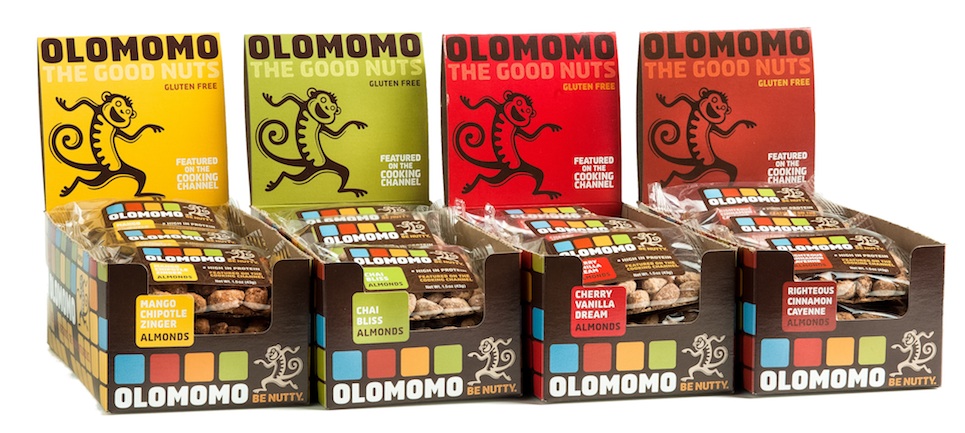
“Part of the motivation behind the new packaging and displays was to create an attractive delivery system that was colorful and visually appealing, with easy identification of flavors, and attributes legibly printed on each bag. Our retail grocery customers spoke and we listened,” said Olomomo CEO Mark Owens.
All Olomomo Nut products are kettle-roasted using centuries-old techniques, and lightly seasoned with individual spices to prevent masking the nut’s inherent flavor. According to founder Justin Perkins, “I’m a weekend-warrior athlete who depends on sustained, even energy. I wanted a food that wasn’t overly sweet or salty; I don’t have time for sugar crashes and ingredients that are dehydrating. Therefore, all of our products adhere to that guiding principle of minimal sugar, low-salt, but tons of flavor.”
Originally inspired by an artist from Oaxaca, Mexico, who used native products to produce intricate art, the folks at Olomomo use simple but distinctive, fair-trade spice combinations to create mind-blowing roasted almond flavors including Cherry Vanilla Dream, Chai Bliss, Mango Chipotle Zinger, and Righteous Cinnamon Cayenne, available in 1.5-oz. and 4-oz. sizes - and Cosmic Maple Masala Pecans, available in 10-oz. bags. The company plans to roll out new flavors later in the year.
Current flavor offerings have the following attributes: all natural and organic ingredients, vegan, gluten free, dairy free, no trans fat, no added oils, no cholesterol, no preservatives, no artificial colors, no artificial sweeteners and no GMO ingredients.
Olomomo Nut Company is a cause-oriented brand with a mission to do and inspire more good in the world while creating a healthy snack alternative. Recent donations have included Kay Angel Orphanage in Haiti, The Center for Resource Conservation, Net Impact, and Cultiva, an organization dedicated to teaching young people about organic gardening.
About Olomomo Nut Company
Olomomo - The Good Nuts™ - offers five varieties of healthful, artisan-roasted, all natural nuts. Since launching in 2008 at a local farmers’ market, Olomomo has grown to be the snack of choice for thousands. Olomomo Nut Co. is a sustainable business with a commitment to fair labor practices, all natural and organic ingredients, and a wide variety of environmental and social causes. Olomomo Nuts inspires people to... ”Be Nutty. Be Good. Be Adventurous™.” Available now at more than 150 natural grocers and cafes nationwide, including Alfalfa's Market, Natural Grocers by Vitamin Cottage, Akin's Natural Foods, and other leading retailers. For information, visit www.olomomo.com or join the community at www.olomomo.com/facebook.
Look for Olomomo Nuts at Natural Products Expo West, March 8-10, 2013, downstairs in Hall E at America's Best Organics, booth #5673, in the
Anaheim Convention Center.
GMO Update: Whole Foods Market to Require GMO Transparency
This past month marked a number of important developments in the ongoing debate to label genetically engineered or GMO foods, including the following news items.
This past month marked a number of important developments in the ongoing debate to label genetically engineered or GMO foods, including the following news items.
Whole Foods Market Announces Mandatory GMO Labeling in Stores by 2018
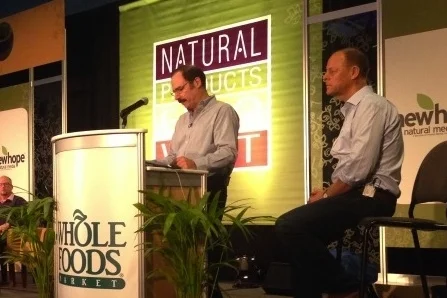
Not waiting for the government to take the lead in the labeling of genetically engineered or GMO foods, Whole Foods Market announced at Natural Products Expo West that it will require GMO transparency for any products sold in its stores by 2018, making it the first national grocery chain to set a deadline to label foods that contain GMO ingredients.
Whole Foods also will require labeling for meat and dairy products if the animals were fed GMO grains. Certified organic foods will not have to carry the label since by definition, organic foods are prohibited from using GMO crops or ingredients. According to Co-CEO A.C. Gallo, the nation’s leading natural and organic products grocer is seeing sales increases of 15% to 30% for non-GMO verified products. Whole Foods told USA Today that is currently sells more than 3,000 products that have gone through the non-GMO verification process, more than any other retailer in North America. Additionally, Whole Foods Market, Aldi’s and Trader Joe’s announced that they would not sell genetically engineered salmon, if FDA approves it. “We are committed to full GMO transparency within five years,” said Whole Foods Co-CEO Walter Robb.
Washington State’s I-522 Leads State GMO Labeling Efforts
After submitting more than 300,000 signatures, Washington State’s I-522, the People’s Right to Know Genetically Engineered Food Act, is considered by many to be the best bet to achieve mandatory GMO labeling in 2013. In February and March, Washington State legislators held hearings, which included testimony from Robert Maquire, an attorney for the pro-GMO biotech lobby, who argued that GMO labeling is not in the public interest. George Kimbrell, an attorney for the nonprofit Center for Food Safety who helped create the GMO labeling measure, disagreed, saying the issue is “a far cry from mere consumer curiosity.” Kimbrell asserted that I-522 would not lead to frivolous lawsuits or increase costs to consumers. Unless the state legislature passes the measure as it stands, which is a rare occurrence, according to the Seattle Times, the I-522 bill will go before voters in the November election. A number of other states are pursuing GMO labeling legislation, including Vermont, Connecticut and Oregon. Efforts in other states, however, including Hawaii, New Mexico, Arizona and Colorado, were defeated or postponed in legislative committees before ever seeing the light of day. However, GMO labeling advocates in both California and Colorado say they’ll be back in 2014. To support and contribute to I-522, visit www.labelitwa.org or contact Steven Hoffman, steve@compassnatural.com.
NPA Calls for National GMO Labeling Standard
After taking heat for coming out against California’s Prop 37 GMO labeling bill in 2012, the Natural Products Association in March called for national GMO labeling. “This is really very simple – people have a right to know what’s in their food,” said NPA’s Executive Director John Shaw. Shaw indicated that a national standard would be best and that different state and local requirements would be counterproductive. Mark Squire, owner of Good Earth Natural Foods in Fairfax, CA, and a proponent of Prop 37, told New Hope 360 that he applauds NPA’s stand, however he hopes to see NPA back Washington State's I-522 GMO labeling bill "because there is a great deal of precedent for laws starting at the state level and then being adopted at the national level. The Obama administration could require labeling immediately, but the question is does anyone in D.C. have the political backbone to listen to the American people when it would require ignoring such a powerful and moneyed lobby as biotech? It may be that passing a law in a state is the only way to get national regulation on this topic," he said.
NPA’s position statement contains five points:
NPA believes consumers have the right to be informed whether genetically modified components are in their foods.
NPA supports and encourages the voluntary labeling on non-GMO foods.
NPA believes that consideration of federal law promoting a uniform standard is warranted to avoid separate standards for GMO labeling at the state level.
NPA opposes a private enforcement provision, which encourages abusive litigation, to impose compliance.
NPA supports the FDA consistently reviewing the concept of bio-equivalency of genetically modified ingredients in light of the most recent scientific studies.
Rep. Jared Polis Announces Federal GMO Labeling Bill
US Congressman Jared Polis (D-CO) announced in late February that he will introduce a federal bill to require mandatory labeling of genetically engineered or GMO foods. The GMO Labeling Bill will be co-sponsored by Rep. Peter DeFazio (D-OR) and in the Senate by Sen. Barbara Boxer (D-CA). “I am proud to help lead the GMO Labeling Bill, which is all about consumer choice and information. It’s important to empower people with the information they need to make their own healthy choices. People have the right to make consumer decisions based on accurate transparency in labeling, and knowledge is power,” Polis said in a press conference held in the new Alfalfa’s Market in Boulder. More than 90% of Americans support labeling of GMO foods, according to a 2012 Mellman Group survey.
Last Minute “Monsanto Protection Act” Takes Away Courts’ Right to Limit GMO Crops In an era of 11th hour budget battles in Washington, D.C., non-GMO advocates are railing over a section introduced at the last minute by an “anonymous” congressman in a federal agricultural appropriations bill called HR 933. The short-term resolution, signed on March 26 by President Obama, contains language dubbed the “Monsanto Protection Act.” Specifically, section 735 of the bill “would limit judges to stop Monsanto or the farmers it sells genetically modified seeds from growing or harvesting those crops even if courts find evidence of potential health risks,” according to the New York Daily News. Advocates are primarily upset over the seemingly blatant collaboration with the biotech industry on the rider in the bill. “Why is this such a big deal?” asked public health attorney Michele Simon in her blog Appetite for Profit. “The court system is often our last hope, with Congress, the White House and regulatory agencies deep inside industry’s pocket. Several legal challenges have resulted in court decisions overturning USDA’s approval of new GMO crops, for example, sugar beets,” she said. Despite the best efforts of Senator Jon Tester (D-MT) – the only organic farmer in Congress – the biotech rider was pushed through. “These provisions are giveaways, pure and simple, and will be a boon worth millions of dollars to a handful of the biggest corporations in this country,” he said.
Note: This article was originally published in the March 2013 issue of Presence News, published by Presence Marketing/Dynamic Presence.